
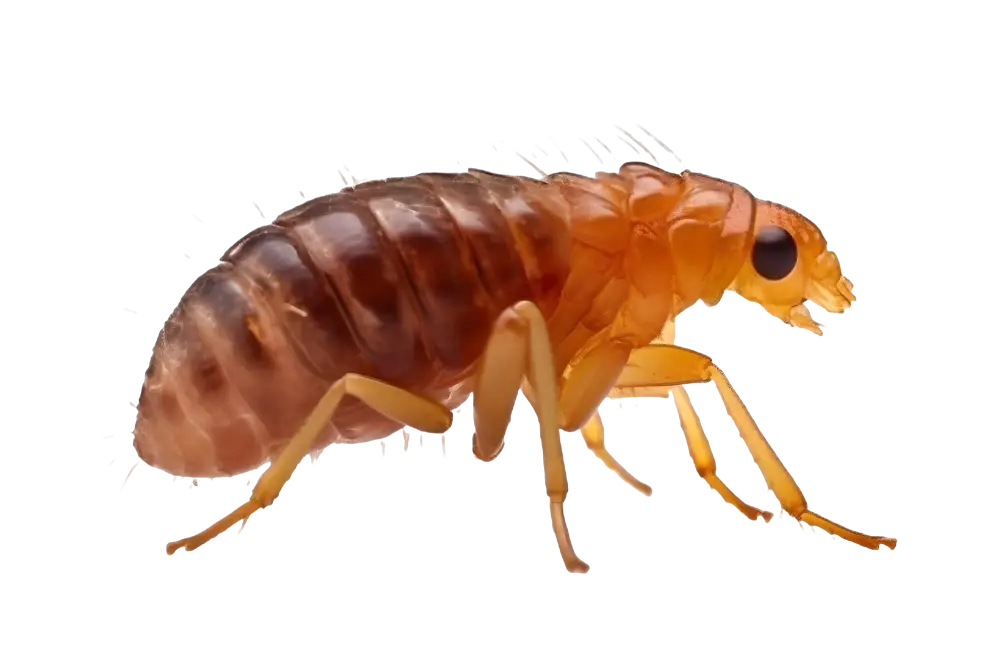
What are fleas and what do they look like?
As a pest controller with more than 20 years of experience, I regularly get the question: “Johan, how do I know if I have fleas?” Because fleas are small and fast - often you don't see them right away. But they do leave obvious marks. Let me explain what to look out for.
What do fleas look like?
Fleas are tiny insects - only 1-3 millimetres long. They are dark brown to black, flat (seen from the side), and have no wings. But they can jump - and they do it well. A flea can jump 30 centimetres high. That's 150 times their own body height!
You rarely see fleas sitting around. They move at breakneck speed and jump away as soon as you get close. Usually you see them as a small dark dot that suddenly jumps away. Or you feel them - when you get bitten.
In the Netherlands, we mainly have to deal with the cat flea. Funnily enough, this is the most common flea in cats, dogs and humans. Dog fleas are rarer. We no longer have human fleas in the Netherlands - they have been eradicated.
The Life Cycle: Why Fleas Are So Persistent
This is important to understand because it explains why fleas are so difficult to control. A female flea lays 20-50 eggs a day on your pet. Those eggs are white, small, and slippery. They don't stay on the animal but fall off - on the sofa, the carpet, your bed, everywhere your pet goes.
In 2-12 days, the larvae hatch. These are white, worm-like, and live in dark places: between carpets, in cracks, behind skirting boards, in couch cushions. They eat organic material, especially the faeces of adult fleas. After 5-11 days, they pupate.
Then come the pupae. The larva makes a cocoon and can survive in it for weeks to months - waiting for the right moment. What is the right moment? When they feel vibrations (someone walks by), sense warmth, or smell CO2. Then the adult flea emerges from the cocoon.
The flea jumps onto a host (your pet or you), bites to suck blood, and starts laying eggs within 24 hours. And the cycle begins again.
Why is this so tricky? Because you have eggs, larvae, pupae AND adult fleas in your home at any time. If you kill only the adult fleas (on your pet), new ones will come out of the pupae within a few weeks. That's why you should treat your whole house, not just your pet.
Would you like to ask a question or make an appointment?
Recognition: these signs give away fleas
Okay, you rarely see fleas yourself. But they do leave obvious marks. And those marks are often the first evidence that you have fleas. Let me explain what to look out for.
Flea bites: The First Tick
Most people only notice fleas through bites. Flea bites are small, red, itchy bumps. They look like mosquito bites, but often have a red dot or scab in the middle - where the flea bit.
Where are they? Mainly on your lower legs and ankles. When you walk around, fleas jump onto your legs from the ground. But also on arms, belly, or back if you have been lying on the sofa or in bed where there are fleas.
Characteristic: flea bites are often in groups of 2-3 bites close together. Or in a row. And they itch tremendously - often worse than mosquito bites. The itching can last for days.
Note that not everyone reacts to flea bites. About 20% of people get no itching or visible bumps. So no bites does not automatically mean no fleas.
Flea droppings: The Evidence
This is the way to know for sure if you have fleas. Flea droppings are small black granules - about the size of a grain of sand or ground pepper. You will find them in places where your pet often lays: in their basket, on the sofa, on your bed, on cushions.
How can you be sure it is flea poo? Place the black pellets on a piece of white paper and wet them with a drop of water. If they smear into a reddish-brown stain, it is flea poo. Because it is digested blood. If it stays black, it's just dirt.
This test is 100% reliable. If you get reddish-brown spots, you have fleas. No doubt about it.
Seeing Fleas on Your Pet
With a heavy infestation, you can sometimes see the fleas on your pet. Where to look. Comb through the coat with a fine-toothed flea comb, especially around the neck, in the armpits, on the belly, and around the tail area.
When you see fleas, they are small dark dots that quickly jump away. Or you may see flea poo in the fur - small black granules.
Use the flea comb over a white piece of paper or sheet. Comb through the coat thoroughly. If small black pellets fall (flea droppings) or small jumping insects (fleas), you know enough.
Your Pet Scratches Extremely
Pets with fleas scratch constantly. They bite their fur, lick their paws extremely, have bald patches from scratching, and are restless and irritable.
Note that some pets are allergic to flea bites (flea allergy). In them, a few fleas are enough for extreme itching. You may only see one or two fleas, but your pet will go crazy with itching.
Just last month: a client with a cat that scratched itself completely bald. She thought it was stress. But we found flea poo in the fur. The cat had a flea allergy. After treatment, the scratching stopped within a week.
The White Sock Test
This is a clever test that I often recommend. Put on white socks and walk around your house for a few minutes. Especially in places where your pet often goes - the living room, bedroom, hallway.
Then look at your socks. Do you see little dark dots jumping? Then those are fleas. Fleas are attracted by vibration, heat and CO2. They jump on your white socks, and that's where you can see them clearly.
This test works especially well if you haven't been home for a while. Because then all the fleas come out of their pupae (they have been waiting for a host) and jump on you en masse.

How do you get fleas? (And how to prevent it)
Good thing you asked! Because fleas don't just come. They need a host to survive. Let me explain how they enter your home and how to prevent it.
Via Your Pet: The Main Route
The vast majority of flea infestation comes in through pets. Your dog or cat walks outside, gets fleas from other animals or the environment, and brings them inside. Once inside, the fleas start laying eggs, and before you know it, you have an infestation.
Where do pets pick up fleas? Contact with other animals (neighbouring cats, dogs in the park, wild animals), in areas frequented by animals (parks, forests), from the previous occupant (flea pupae can survive for months in an empty house), and through gardens frequented by other animals.
What I often see: people moving to a new house. The house had been empty for months. They enter with their pet. Because of the vibrations and heat, all the fleas (which were waiting like pupae) come out of their cocoons at once and jump onto the pet. Within a day, the pet has dozens of fleas.
From Previous Residents
Flea pupae can survive for 6-12 months without a host. They wait patiently in carpets, floor cracks, behind skirting boards. When you come in (heat, vibration, CO2), they come out of their cocoon. If you have a pet, they jump right on that. If you don't have a pet, they bite you.
This is especially common in rental houses where the previous tenant had pets. The house is empty for a while, and then a new tenant moves in. Suddenly, they have fleas - even though they don't have a pet themselves (or just bought one).
My advice if you move to a house where pets were: have the house thoroughly vacuumed (especially carpet) before moving in. Or even better: have it preemptively treated. Costs little, saves a lot of misery.
Wild Animals in Crawlspace or Attic
Don't have pets but still have fleas? Then they probably come from wild animals. Mice, rats, martens, or hedgehogs in your crawlspace or attic may have fleas. When those animals die or leave, the fleas look for a new host - and that's you.
What I regularly see: people with fleas who don't have pets. We then find a dead mouse in the crawl space or behind a cupboard. The mouse had fleas, and they have come upstairs in search of a new host.
How to prevent fleas
Prevention is the best fight. My practical tips. Protect your pets - use preventive flea treatment for your dog or cat. There are excellent remedies: spot-on (drops in the neck), tablets, or flea collars. These kill fleas before they can lay eggs. Ask your vet for advice.
Check regularly - comb your pet weekly with a flea comb. This will help you detect fleas early, before they become an infestation. Vacuum often - this removes eggs, larvae and some of the pupae. Pay particular attention to areas where your pet often lays. Throw the vacuum bag away afterwards (outside!) or empty it directly into the outdoor container.
Wash beds and cushions regularly - wash your pet's basket, couch cushions, and your own bedding regularly at 60°C. This kills fleas at all stages. When moving house - if you move to a house where pets were, have it thoroughly vacuumed or treated preventively.
And fight rodents - do you have mice or rats? Combat them. Because they can bring in fleas.
Would you like to ask a question or make an appointment?
Why fleas are so annoying (and sometimes dangerous)
You might be thinking, “It's just fleas, how bad can it be?” Well, let me be honest: fleas are hugely annoying and can even pose health risks. I'll explain why.
The Itch: Often Underestimated
Flea bites itch extremely. Much worse than mosquito bites. The itching can last for days, and scratching only makes it worse. You can lie awake at night because of it. Children sometimes scratch themselves open, which can lead to infections.
For pets, it is even worse. They can't hold back and scratch constantly. This leads to bald patches, open wounds, and skin infections. Some animals literally scratch themselves sick.
I have had clients who did not sleep well for weeks because of flea bites. New bites every night, extreme itching every day. It affects your whole life.
Flea allergy: Severe reaction
Some people and animals are allergic to flea saliva. In them, just one flea bite can cause severe itching and skin rashes. The skin becomes red, swollen, and extremely irritated.
In pets with flea allergy, you see extreme itching from just a few fleas, bald patches especially on back and tail, open wounds from scratching, and thick inflamed skin.
These animals must remain 100% flea-free. Even one flea is too many. That makes treatment extra important.
Leeches: Anaemia In Heavy Infestation
Fleas suck blood. In a heavy infestation, they can suck so much blood that young or weak animals become anaemic. This is especially dangerous for kittens and puppies.
Signs of anaemia: pale gums, weakness and apathy, no appetite, and rapid heartbeat. This is a medical emergency - go to the vet immediately.
Transmitting diseases
Fleas can transmit diseases. In the Netherlands, the risk is small, but it exists. Tapeworm - fleas can carry tapeworm eggs. If your pet swallows a flea, it gets tapeworm. Recognisable by white segments in the faeces.
Cat scratch disease - fleas can spread the bacterium Bartonella henselae. If a cat scratches or bites you, you can get cat scratch disease - fever, swollen lymph nodes, fatigue.
And mouse typhus - very rare, but fleas from rats and mice can carry mouse typhus bacteria.
In the Netherlands, these risks are small. But it is good to know.
Rapid Dissemination
Fleas multiply at lightning speed. A female lays 20-50 eggs a day. Within 3 weeks, you have a new generation. In ideal conditions, one flea pair can lead to 250,000 offspring in 60 days (theoretically).
What I often see: someone discovers a few fleas on their dog. “Oh well, are only a few.” Two weeks later, they're everywhere - in the carpet, on the sofa, in bed. Itching everywhere, fleas everywhere. Control then takes weeks.
That's why I always say: if you see fleas, tackle it immediately. Don't wait. The sooner you start, the easier and quicker you will get rid of them. And the less itching and misery you will have.
Frequently asked questions about fleas
These are the questions I get most often about fleas. Is your question not among them? Feel free to call me for personal advice.
Flea bites are small, red, itchy bumps often with a red dot or scab in the middle. They resemble mosquito bites but often itch worse and longer. Characteristic: they are often in groups of 2-3 close together, or in a row. You find them mostly on lower legs and ankles (fleas jump on you from the ground), but also on arms, belly or back if you have been lying on infected areas. The itching can last for days. Note that not everyone reacts - about 20% do not get visible bites.
The most reliable test: look for flea droppings (small black grains like ground pepper) in places where your pet lies. Place them on a piece of white paper and wet them. If they smear into a reddish-brown stain, it is flea droppings (digested blood). This is 100% evidence of fleas. You can also do the white sock test: put on white socks and walk around. Do you see little dark dots jumping? Then those are fleas. Or use a flea comb on your pet - if fleas or flea droppings fall out, you know enough.
Yes, it's possible. Three possible causes: you live in a house where the previous occupant had pets - flea pupae can survive 6-12 months and hatch when you move in. Wild animals (mice, rats, martens) in your crawlspace or attic have fleas - when those animals die or leave, the fleas look for you as a new host. Or you may have visited someone with fleas and brought them with you in your clothes. In the Netherlands, we no longer have human fleas - it's always cat or dog fleas that also bite people.
For a small, incipient infestation, you can try. Treat your pets with good flea medication (from the vet, not the supermarket). Vacuum your whole house daily, especially carpet and upholstery. Wash everything that can at 60°C (beds, cushions, dog mat). Repeat for 2-3 weeks. But honestly, with an established infestation, it rarely works well. Because you often miss pupae sitting in cracks, DIY remedies don't penetrate everywhere, and the timing has to be perfect. Then you have them back weeks later. For heavy infestation or if you can't get it under control yourself: call a professional.
With professional treatment: 2-4 weeks. Why so long? Because flea pupae are protected in their cocoon - no drug kills them. They have to hatch as adult fleas first, and then treatment kills them. This process takes 2-3 weeks. Therefore, aftercare is crucial: vacuum daily (encourages pupae to hatch), wash textiles, and keep treating your pets. After 2-3 weeks, you will see that new fleas die immediately. After 4 weeks, you should be flea-free. In case of very heavy infestation or if you don't do aftercare properly, it may take longer.
Make an appointment with a professional pest controller now
Make an appointment with our certified pest controllers now! If you complete the form below, we will contact you to make an appointment directly make