
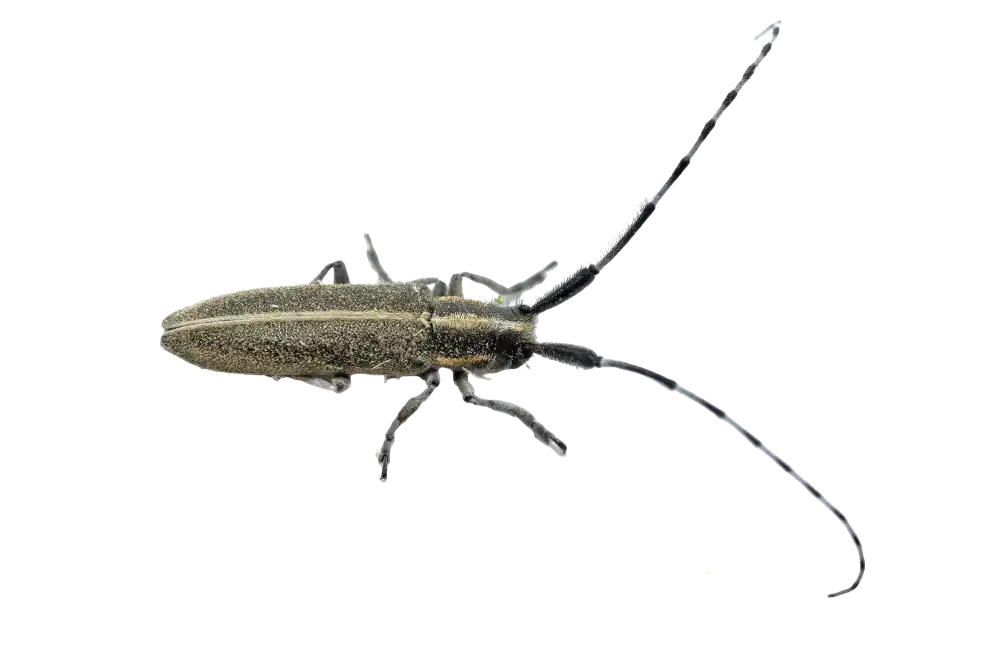
What are longhorn beetles and why are they worse than woodworms?
As a pest controller with more than 20 years of experience, I sometimes get the question: “Johan, do I have longhorn beetles?” And frankly, if the answer is yes, I'm a bit shocked myself. Because longhorn beetles are the heavyweights among wood-eaters. Let me explain why.
Longhorn beetles: bigger and more aggressive
Longhorn beetles are much larger than ordinary woodworms. An adult longhorn beetle is 10-20 millimetres long - 3 to 4 times larger than an ordinary wood beetle. They are black to dark brown, flat, and have long antennae. Hence the name “buck” beetles.
But the real problem is the larvae. A boxelder larva can grow 20-30 millimetres long - the size of a little finger. And they chew through the wood for 4-10 years before they become adults. During that time, they do enormous damage.
The difference with woodworms? A woodworm larva makes tunnels of 1-2mm. A boxelder larva makes tunnels of 6-10mm. That's 4-5 times wider. And they can be much deeper into the wood - up to 5 centimetres deep.
Softwood only
This is important to know: longhorn beetles are only found in softwood (spruce, pine, fir). You will never find them in hardwood. This is different from common woodworms, which can be in almost any type of wood.
Where is there risk? Roof structures (beams, rafters, purlins), wooden floors made of spruce, frames made of softwood, old wooden facades, and barns made of untreated softwood.
Why this difference? Because buck larvae feed on the starch in the sapwood of softwood. Hardwood contains too little of these substances for them.
The Life Cycle: Why It Takes So Long
Let me explain the cycle, because that explains why longhorn beetles are such a problem. In summer (June-August), females lay 150-200 eggs in cracks of warm softwood. They prefer to choose roof structures that warm up nicely in the sun.
Then the larvae hatch and eat through the wood for 4 to 10 years. Yes, really that long! During that time, they make huge corridors and cavities. They produce huge amounts of borer meal.
When fully grown, the larva pupates just below the surface. After a few weeks, the beetle hatches by biting a 6-10mm oval hole. The female lays eggs again, and the cycle begins again.
Just last summer: a client with longhorn beetles in his roof structure. We estimated that the infestation had been going on for at least eight years. Three beams were so badly affected that they had to be replaced. Cost: €8,000. Such is the danger of longhorn beetles.
Would you like to ask a question or make an appointment?
Recognition: this is how you know if you have longhorn beetles
OK, you suspect longhorn beetles. But how do you know for sure? Because the signs look like woodworms, but are bigger and more serious. Let me explain what to look out for.
Exit holes: Remarkably Large
This is the first difference from woodworms. Longhorn beetle exit holes are 6-10 millimetres in diameter - about the size of a pencil. They are oval rather than round, and often have ragged edges. Not as neat as with woodworms.
If you see holes of 6mm or larger in softwood, they are almost certainly longhorn beetles. Common woodworms never make such large holes.
Fresh holes can be recognised by light, clean edges and fresh borax around them. This means that beetles have recently hatched - the pest is active.
Drill flour: many and coarse
Longhorn beetle larvae produce large amounts of borer meal. It is coarser than in woodworms - more like coarse sawflakes. The colour is light (cream to yellowish), and you often see large oval pellets in it.
Important: you often find large quantities. Heaps of centimetres high are not unusual in a heavy longhorn beetle infestation. This is much more than with woodworms.
You can find borer meal under fly holes, in cracks in wood, on the floor under roof beams, and sometimes even in insulation material when larvae hide in it.
Sounds in The Wood
This is unique to longhorn beetles: you can hear them. Especially at night, when it is quiet, you can sometimes hear a scratching sound or gnawing noise coming from the wood. These are the large larvae eating through the wood.
I have had customers who thought there were mice in the attic, but it turned out to be longhorn larvae in the beams. The sound is quite loud for such a small creature.
If you hear this, you probably have a big infestation. Because you won't hear one or two larvae - but dozens will.
Deep corridors and cavities
If you break open affected wood, you will see large corridors 6-10mm wide. The wood is often largely hollowed out. The strakes run through each other and make the wood extremely weak.
What is striking: the corridors often run parallel to the wood grain, deep into the heartwood. This is different from woodworms, which are more in the sapwood (outer layers).
Just last month: we removed a beam from a roof. From the outside, it looked reasonable - a couple of fly holes, some drill flour. But when we sawed it through, it was hollowed out for 60%. It had only a fraction of its original strength left. That's how dangerous longhorn beetles are.
Adult Beetles: Large and Dark
In the summer months (June-August), you sometimes see the adult beetles. They are 10-20mm long, black to dark brown, flat, and have those characteristic long antennae.
You find them mostly in the attic, against windows (are attracted to light), on or around roof beams, or dead in cobwebs. If you see these large beetles, you have an active infestation.

Why do longhorn beetles come and how do you prevent them?
Good thing you asked! Because longhorn beetles don't just come. They need specific conditions. If you understand what they are looking for, you can prevent them from entering your home. Let me explain.
What attracts longhorn beetles?
Longhorn beetles look for warm, dry softwood to lay eggs in. This is different from common woodworms, which actually like damp. Longhorn beetles like roof structures that heat up in the sun, attics without insulation (where it gets very hot in summer), wooden facades facing south or west, and untreated softwood outdoors.
Old, untreated wood is also attractive. Wood without a protective coating (paint, stain), wood with cracks in which beetles can lay eggs. And older wood (above 20-30 years) is especially attractive.
What I often see: old houses with uninsulated attics are riskier. In summer, it gets 40-50 degrees in there. Perfect for longhorn beetles.
How Do They Get Into Your House?
In three ways. They are already in the wood - in old houses, the infestation has often been in the original roof structure for years. You bring in infested wood - firewood, old beams you reuse, second-hand furniture made of coniferous wood. Or adult beetles fly in during the summer in search of suitable wood.
Last year, I had a client in a new house (5 years old). He had longhorn beetles in his roof structure. How could that be? The wood was already infested when it was delivered. The infestation was already in the wood when the house was built. Unfortunately, this is more common than you think.
Prevention: how to keep longhorn beetles out
Want to avoid getting longhorn beetles? My practical tips. Treat new softwood preventively - have all softwood roof beams preventively treated with longhorn beetle repellent before installation. This is the best prevention.
Inspect your attic regularly. Check annually in August/September for fly holes and borer meal. The earlier you detect an infestation, the easier it is to control.
Insulate your attic - this lowers the temperature in summer. Longhorn beetles love heat; a cooler attic is less attractive. Don't use untreated firewood inside - always stack firewood outside, not in the attic. Firewood can contain longhorn beetle larvae.
Repair cracks in wood - beetles lay eggs in cracks. Sand off old paint, fill cracks, and re-treat the wood. And ventilate well - ensure good ventilation in the attic. Extreme heat attracts longhorn beetles.
Would you like to ask a question or make an appointment?
Damage from longhorn beetles: why they are so dangerous
Let me be honest: longhorn beetles are the most destructive wood-eaters in the Netherlands. They can so seriously weaken load-bearing structures in a matter of years that they collapse. I explain why they are so dangerous.
Structural Hazard: Collapse risk
This is the biggest problem. Longhorn beetle larvae make large corridors (6-10mm) through load-bearing beams. In 5-10 years, they can hollow out a beam for 70-80%. The wood loses its load-bearing capacity and may collapse.
Where does it get really dangerous? At roof beams supporting the roof - if they collapse, your roof collapses. At floor joists - floor can collapse. At purlins and rafters - whole roof structure can weaken. And at load-bearing walls of wooden facades.
I have stories from customers where a roof beam broke during a snowstorm. The beam had been completely hollowed out inside by longhorn beetles. Fortunately, no one was home. But it could have been life-threatening.
This is why I always say: if you suspect longhorn beetles in your roof structure, get it inspected DIRECTLY. This is not a problem you can ignore or put off.
Speed of Damage
Longhorn beetles work slowly but steadily. A larva eats through the wood for 4-10 years. But because there are usually dozens of larvae in a beam at a time, the damage goes much faster together.
What I often see: years 1-3 you don't notice much. Maybe some drill flour, an occasional fly hole. But the problem is deep in the wood where you don't see it. Years 4-7 the damage becomes visible. More flyholes, lots of borer meal, the wood feels hollow. Year 8-10, the damage is critical. Beams are structurally weakened and need to be replaced.
The problem is that you don't see it until it is already serious. The larvae are deep in the wood and do their work silently. By the time you see large numbers of fly holes, the infestation has been going on for years.
Distribution Throughout the Roof
Longhorn beetles do not stay in one beam. When adult beetles fly out, they look for new wood nearby. Thus, the infestation spreads throughout your entire roof structure.
What I often see: it starts in one beam. But after a few years, they are in 3-4 beams. And after 10 years, your entire roof structure is affected. Then you're talking tens of thousands of euros.
Last year, I had a client who had ignored longhorn beetles for 15 years. We had to replace 8 roof beams, plus purlins and parts of the roof structure. Total cost: €35,000. If he had dealt with it 10 years earlier, it might have been €3,000.
Cost of Recovery
Longhorn beetle control is more expensive than woodworm control. Why? Because you often have to treat deeper, sometimes beams have to be replaced, and the treatment is more complex.
Average cost I see: abatement alone without replacement €1,500-€3,000. With single beams replaced €5,000-€10,000. With severe damage (multiple beams) €10,000-€40,000. Plus any damage to insulation, ceilings, roofing.
This is why early detection is so important. The earlier you intervene, the cheaper. An annual inspection of your attic costs nothing, but can save you thousands of euros.
What If You Do Nothing?
Sometimes people ask, “What will happen if I do nothing?” Well, let me be honest: infestation doesn't stop on its own. Longhorn beetle larvae keep eating until they reach adulthood. And the beetles lay eggs again. The damage only gets worse.
You end up with collapse of parts of your roof, dangerous situations, unsellable house (when inspected it is discovered), huge repair costs, and problems with insurance (often do not cover negligent maintenance).
Therefore: if you suspect longhorn beetles, call me today. I visit you, inspect thoroughly and give you honest advice. Early intervention can save thousands of euros and prevent dangerous situations.
Frequently asked questions about longhorn beetles
These are the questions I get most often about longhorn beetles. Is your question not among them? Feel free to call me for direct advice.
The main difference is in size and damage. Longhorn beetles are much larger: adult beetles 10-20mm (vs 3-5mm), larvae up to 30mm (vs 5mm), exit holes 6-10mm (vs 1-2mm). Longhorn beetles cause much more damage because their holes are 4-5x larger and they eat 4-10. Also, longhorn beetles are ONLY in softwood, while woodworms can be in almost any type of wood. Finally, longhorn beetles are more dangerous to structures - they can seriously weaken load-bearing beams. Woodworm control costs €500-€1500, longhorn beetle control often €1500-€5000+ if beams need to be replaced.
Longhorn beetle exit holes are remarkably large: 6-10mm diameter (the size of a pencil). They are oval rather than round, often have ragged edges (not neat like woodworms), are always in softwood (spruce, pine, fir), and you will find large amounts of coarse borer meal around them. Fresh holes have light, clean edges. If you see holes 6mm or larger in softwood, they are almost certainly longhorn beetles. Normal woodworms never make such large holes. If in doubt: send me a photo and I can tell you straight away.
Yes, longhorn beetles are the most destructive wood-eaters in the Netherlands. They can weaken load-bearing roof beams to the point of collapse. Why so dangerous? The larvae make large corridors (6-10mm) and eat through the wood for 4-10 years. During that time, they can erode a beam for 70-80%. This leads to collapse risk of your roof, structurally unsafe situations, and repair costs of €10,000-€40,000 for severe damage. Longhorn beetles are not a cosmetic problem - they are a structural safety problem. That's why you should tackle them immediately if you suspect them.
No, longhorn beetle control is really specialist work. Why not do it yourself? The larvae are up to 5cm deep in the wood - DIY remedies won't reach them. You need professional injection equipment to get agents deep into the corridors. You can't assess whether beams are still safe or need replacing - that requires expertise and sometimes a structural engineer. You are likely to miss severely deteriorated beams that still look reasonable on the outside. And if you don't do it properly, the infestation will just keep going and the damage will only get worse. With longhorn beetles, professional help is not a luxury but a necessity.
Prevention in new construction and renovation is crucial. Have all softwood roof beams preventively treated with longhorn beetle repellent BEFORE installation. In existing construction: inspect your attic annually (August/September) for fly holes and borer meal, insulate your attic well (longhorn beetles like heat - cooler attic is less attractive), repair cracks and cracks in wood where beetles can lay eggs, don't use untreated firewood inside, and ventilate your attic well. Early detection is the best prevention - the earlier you detect an infestation, the smaller the damage and costs.
Make an appointment with a professional pest controller now
Make an appointment with our certified pest controllers now! If you complete the form below, we will contact you to make an appointment directly make